Fun Facts About Congaree National Park

Here are some interesting facts about Congaree National Park to help you get to know the Park a little better before you visit.
It’s one of the least visited national parks
Toward the end of the first quarter of the year, the United States National Park Service releases data on the recreational visits to all park units for the previous calendar year. In 2025, Congaree National Park ranked only 49th out of the 63 parks for recreation visits.
About 288,000 guests explored Congaree in 2025, compared to more than 11.5 million who visited Great Smoky Mountains National Park (the most visited park).
It’s one of the smallest National Parks
In addition to ranking near the bottom of the heap for recreation visits, Congaree is near the bottom of the list in size. At only 26,000 acres, few National Parks are smaller than Congaree.
By comparison, Yellowstone National Park is more than 2 million acres. The biggest National Park is Alaska’s Wrangel-St. Elias, and it’s more than 13 million acres.
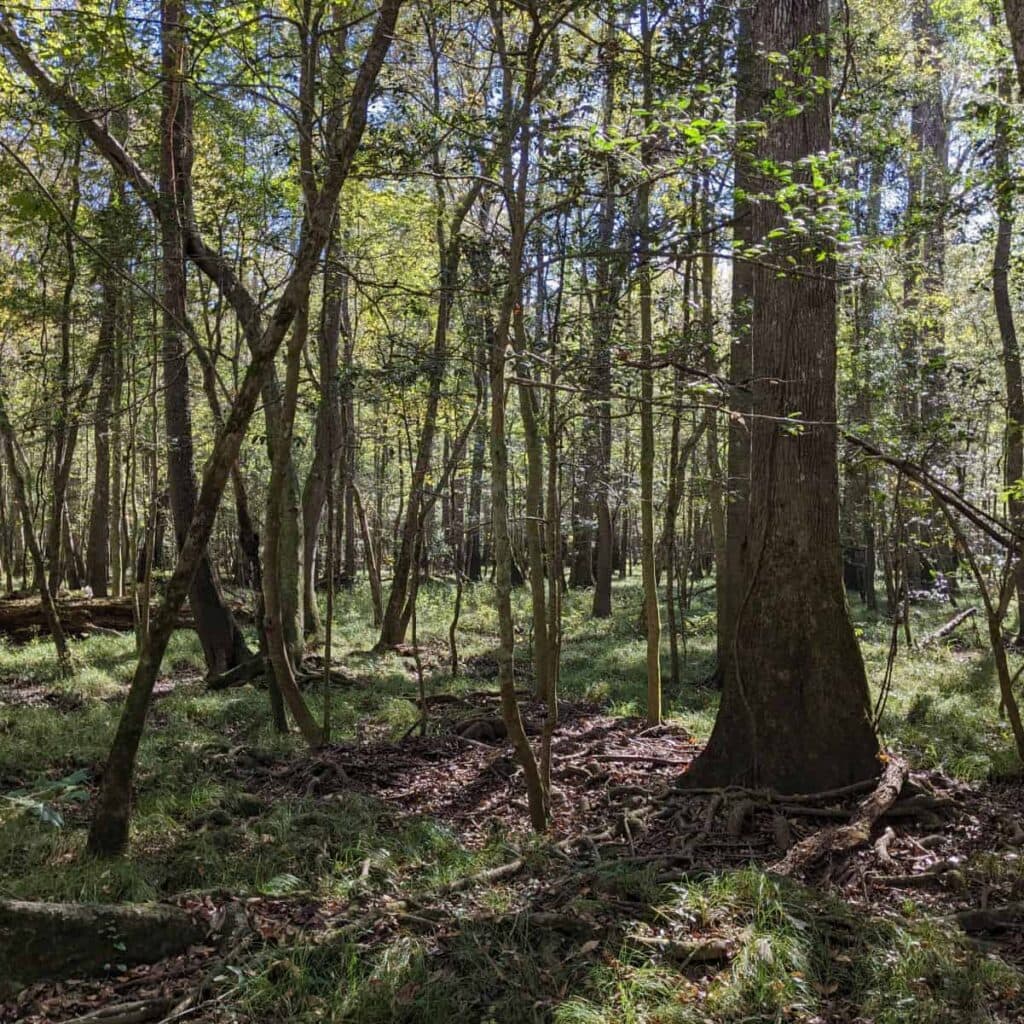
It protects important South Carolina forest land
According to the National Park Service, the Park preserves “the largest intact expanse of old-growth bottomland hardwood forest remaining in the southeastern United States. Waters from the Congaree and Wateree Rivers sweep through the floodplain, carrying nutrients and sediments that nourish and rejuvenate this ecosystem and support the growth of national and state champion trees.”
In the early 1900s, the land that would eventually become Congaree National Park was owned by a lumber company. The company cut millions of acres of forest that once covered this part of the country, leaving only a few large trees standing.
Congaree holds a lottery every year to watch the synchronous fireflies
Congaree is home to synchronous fireflies that hatch each year between mid-May and mid-June. Because viewing these fireflies is quite popular, the National Park Service has to implement a lottery system through the recreation.gov website to limit the number of guests attending.
We attended the synchronous firefly viewing a few years ago and really enjoyed it.
Great Smoky Mountains National Park has a similar synchronous firefly lottery each year.
Congaree National Park is free to enter
Entrance to Congaree National Park is free, and it’s open 24 hours a day, all year round. The only exception to this is during the two weeks of the synchronous firefly viewing, when the park closes to all but those holding reservations.
There is a Visitor Center open nearly every day where you can talk with park staff, explore the gift shop, and stamp your parks passport.
They’re famous (infamous?) for the mosquitoes
Be warned. Congaree is swampy and famous (infamous?) for its mosquitoes. Protect yourself accordingly. You can check with the Park before your trip to find out what the mosquito levels are.
You may have seen photos of the Congaree “Mosquito Meter.” This is not a thing. Well, I mean it exists, but the Park doesn’t use it as a daily indicator of mosquito levels. It’s completely unscientific, and they’ve even described it as a prop for photos. The important takeaway here is that you should be aware of the mosquitoes before you visit.
Not all Congaree trails are on dry land
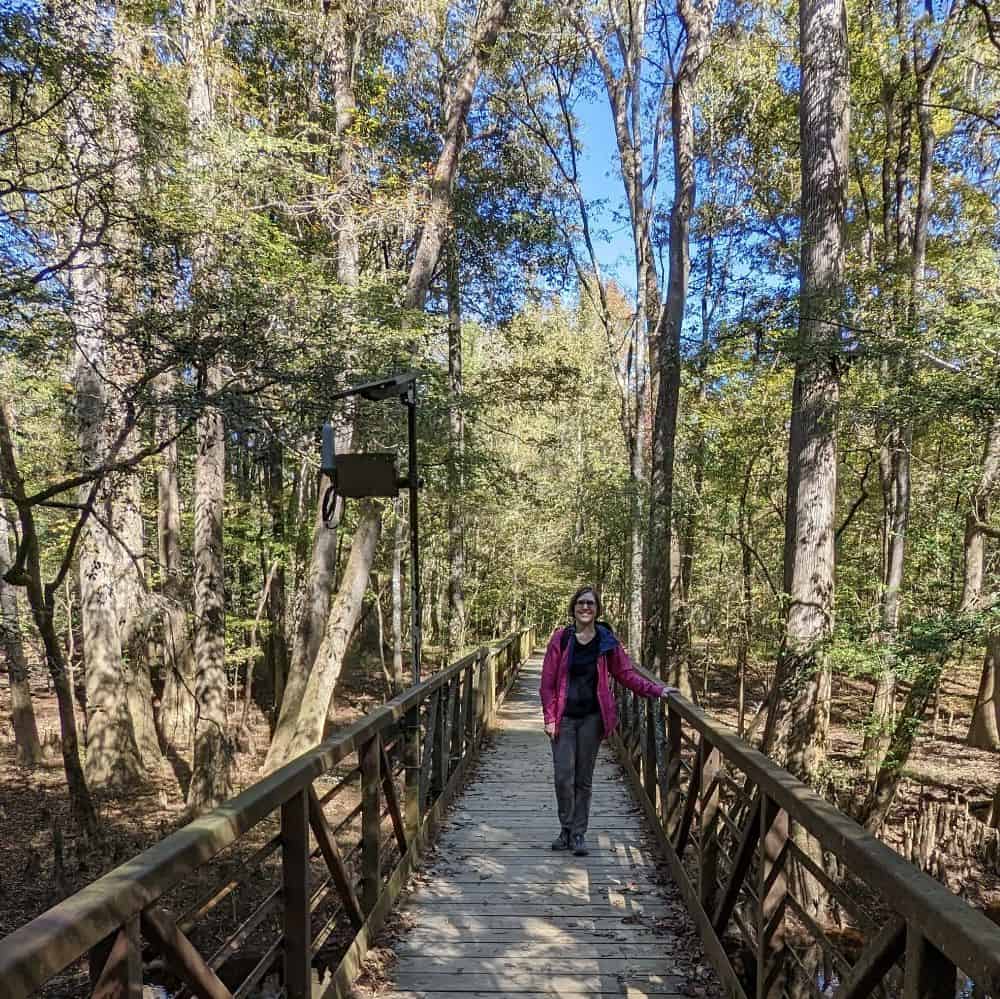
Hiking is a great way to explore Congaree. There are 11 official hikes, but there is also a Canoe Trail that follows Cedar Creek through the heart of the Park.
The trail is marked, but markers may not be visible when water levels are high (Congaree is prone to flooding, by the way), so make sure you have a map and a compass if you attempt this trail.
Congaree became a National Park in 2003
Harry Hampton, for whom the Congaree National Park Visitor Center is named, worked to preserve these amazing trees. When logging again threatened the area, tireless advocates convinced the landowners to sell to the federal government, and Congaree Swamp National Monument was established in 1976. Congaree became a full National Park in 2003.
The bottom line
Congaree may not top the charts in size, nor may it be one of the most popular National Parks, but that’s arguably part of its appeal. This is a park where you can still feel like you’ve stumbled onto something special: ancient trees, fireflies, and swampy creeks that have been lovingly protected by those who understand their worth. If you don’t mind the mosquitoes, it’s well worth the trip.
👉 Keep track of all your trip details with the Plug-and-Play Travel Planning Toolkit.